
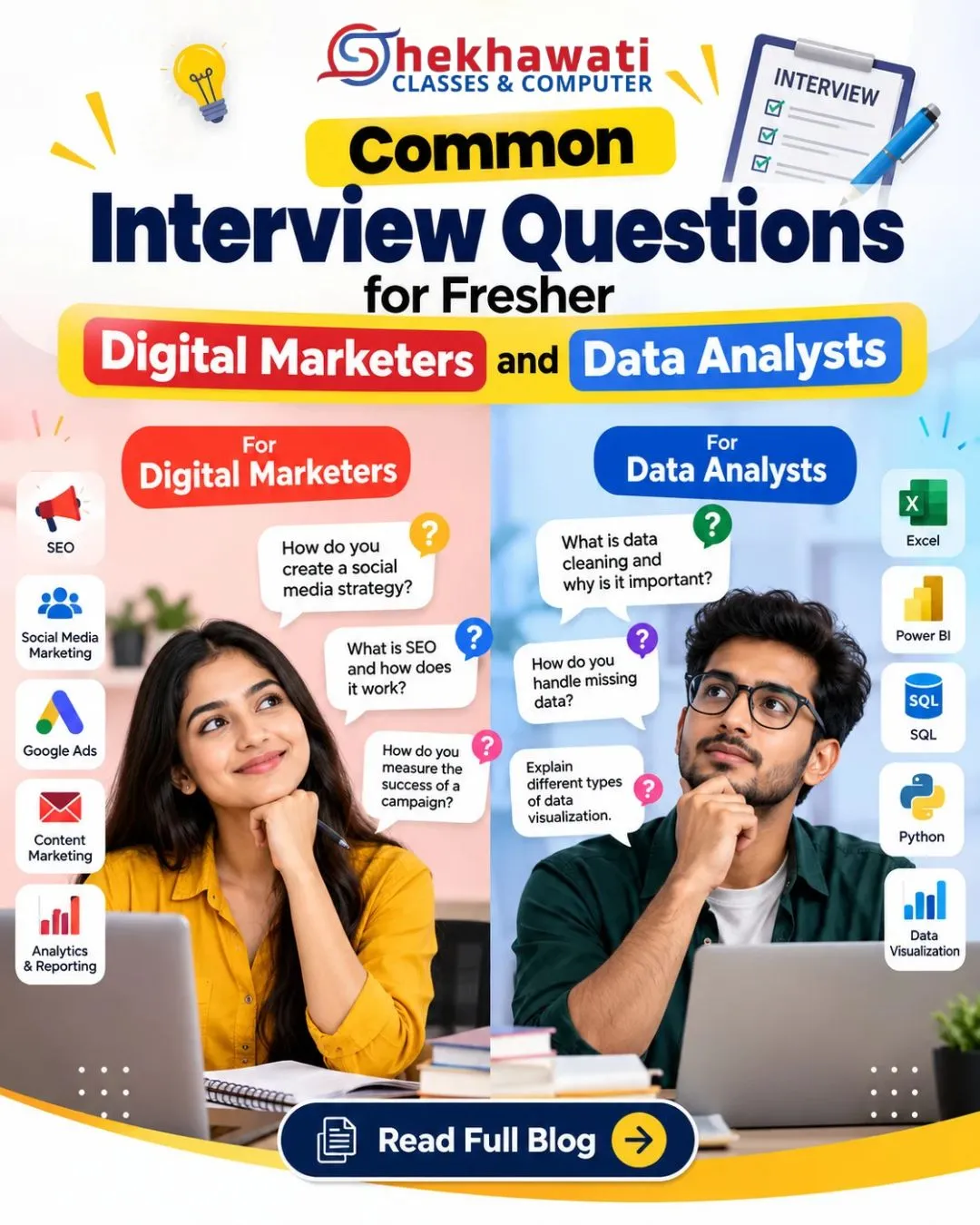
Common Interview Questions for Fresher Digital Marketers and Data Analysts (With Sample Answers)
Let me guess how this went. You finished your course, made your resume, and applied to a few places. Then the call came, "Can you come for an interview tomorrow?", and suddenly every definition you knew has gone out of your head.
It happens to almost every fresher, so relax.
Here's something that might help. Interviewers who hire freshers aren't expecting an expert. They usually want to see three things. Do you know the basics? Can you explain them in simple words? Are you someone who will learn on the job?
So read the questions below, but don't memorise the answers. Say them out loud two or three times in your own words. That's what makes the difference.
If you're going for a digital marketing role
Ques 1: What is digital marketing?
Ans 1: This is usually the first question, and people overthink it. Just say it plainly: it's promoting a business online, through search engines, social media, email and websites, so the right people find it and become customers. Then add one example, like a local shop getting calls because it shows up on Google Maps.
Ques 2: What's the difference between SEO and paid ads?
Ans 2: Think of SEO as slowly building a shop in a good location. It takes time, but people keep coming. Paid ads are like putting up a hoarding. You get attention fast, but it disappears the day you stop paying. Most businesses need both.
Ques 3: How does Google Ads work?
Ans 3: Advertisers bid on keywords, and Google shows their ad when someone searches for that term. But the highest bidder doesn't always win. Google also checks how relevant your ad is and how good your landing page is. You normally pay only when someone clicks.
Ques 4: Which numbers do you look at to know if a campaign is working?
Ans 4: Don't just list full forms. Say what you'd check and why. Click-through rate tells you if the ad is interesting. Conversion rate tells you if people actually took the action you wanted. Cost per lead tells you if the money is being used well. One sentence on each is enough.
Ques 5: How would you promote a small shop in Jaipur with a low budget?
Ans 5: This is where freshers can stand out. You could say: "I'd first make sure the Google Business Profile is complete, because that's how people find shops near them. Then I'd use WhatsApp Business for existing customers, post short reels with the area name, and try a small local ad. After a couple of weeks I'd see what brought calls and visits and put more money there."
Ques 6: Which tools have you used?
Ans 6: Be honest. Don't list ten tools you only opened once. Name two or three and say what you did in them. "I used Search Console on my practice blog to see which searches were bringing people" is much stronger than a long list.
Ques 7: What is GEO or AEO?
Ans 7: If you know this, you'll impress them. It's about writing and structuring content so that AI tools like ChatGPT, Gemini and Google's AI Overviews can understand it and recommend it. People now ask AI directly instead of clicking through ten links, and businesses need to be visible there too.
If you're going for a data analyst role
Ques 8: What does a data analyst actually do?
Ans 8: Say it like this: "I take raw data, clean it, find patterns, and present them so people can make better decisions." Simple and clear is enough.
Ques 9: Walk me through how you'd approach a data project.
Ans 9: Start with the question, not the data. What does the business want to know? Then collect the data, clean it, explore it, make charts, and finally explain what you found and what to do next. Interviewers love it when a fresher starts with the question.
Ques 10: Why is data cleaning important?
Ans 10: Because messy data gives wrong answers, and nobody notices until a wrong decision has been made. Duplicates, blank cells and inconsistent spellings are very common in real data.
Ques 11: VLOOKUP or XLOOKUP?
Ans 11: XLOOKUP is the newer and more flexible one. It can look in any direction, doesn't break when columns move, and handles missing values better. VLOOKUP can only look to the right.
Ques 12: What's the difference between WHERE and HAVING in SQL?
Ans 12: WHERE filters rows before grouping. HAVING filters after grouping. A quick example helps: "WHERE picks orders from 2026, and HAVING then keeps only the customers who ordered more than five times."
Ques 13: How do you handle missing data?
Ans 13: Don't jump to "I'd delete it." Say that it depends. If only a few rows are missing, you can remove them. Otherwise you might fill them with the average or median. But first you'd find out why the data is missing.
Ques 14: What makes a good dashboard?
Ans 14: One that someone can understand in five seconds. A clear question, simple charts, and the most important number at the top. If people need you to explain it, it needs fixing.
Ques 15: Tell me about a project you've done.
Ans 15: For freshers, this is the question that matters most. Pick one project, even a course project, and tell it like a short story: the problem, the data, what you did, and what you found. Two minutes is enough. Practise this one the most.
The three questions everyone gets
Ques 16: Tell me about yourself.
Ans 16: Keep it under a minute: your education, the course you did, one project you're proud of, and why you want this job. Don't tell your whole life story.
Ques 17: What's your weakness?
Ans 17: Pick a real one that you're already working on. "I haven't done much advanced SQL yet, so I'm practising on public datasets" is a good answer.
Ques 18: Do you have any questions for us?
Ans 18: Always ask something. "What would a fresher learn in the first three months here?" shows you're thinking about growth.
One more thing before you go
If you take only one piece of advice from this post, make it this: build one small thing you can show.
For marketing, that could be a practice blog, a Google Business Profile you cleaned up, or a sample month of social media posts. For data, it could be a dashboard built from a public dataset. When you have something to show, every question becomes easier, because you're describing your own work and not reciting definitions.
That's exactly how we teach at Shekhawati Classes and Computer in Jaipur. Our Digital Marketing and Data Analytics courses are built around practical work you can talk about in interviews. Visit us or call to ask about the next batch.
Enroll today, the best computer institute in Jaipur, and open the path for career opportunities.
Start your journey today and build a successful career in digital marketing with AI.
Institute Location: Near Chitrakoot Stadium, Vaishali Nagar & Joshi Marg, Kalwar Road, Jhotwara, Jaipur.
Call us: 7240777700 / 9828756444
Visit Course Page: Best Digital Marketing Course in Jaipur