
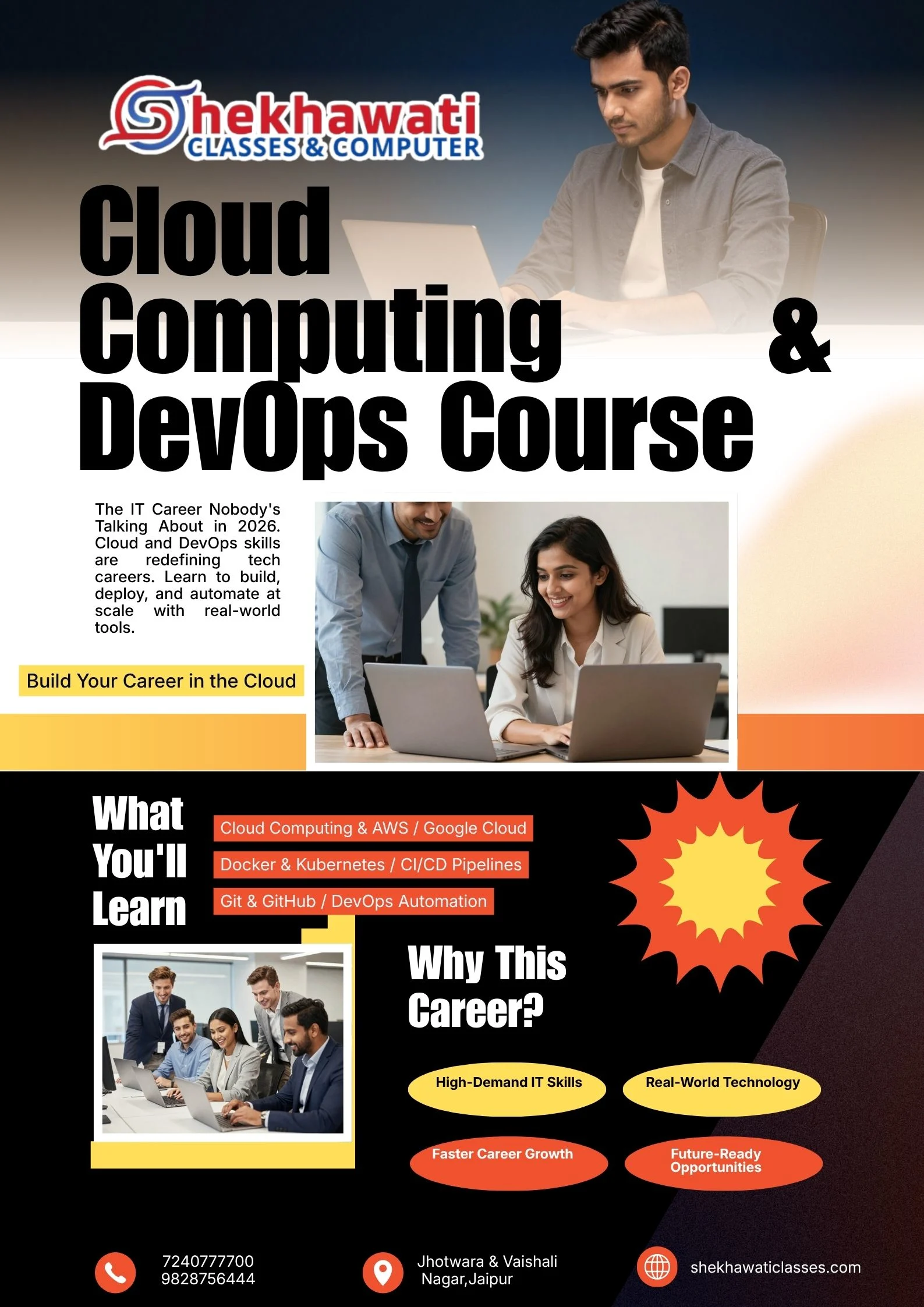
Cloud Computing & DevOps: The IT Career Nobody's Talking About in 2026
Ask any student in Jaipur what IT career they're planning to chase, and you'll hear the same three answers on loop: web development, data analytics, or "something in AI." Cloud computing and DevOps barely come up — not because they're less valuable, but because nobody's really talking about them the way they talk about the trendier titles.
That's strange, because almost every app, website, and AI tool students use every day is running on cloud infrastructure somewhere, and someone has to build, deploy, and keep that infrastructure running. That "someone" is a cloud or DevOps engineer, and right now, there aren't enough of them.
What Cloud Computing and DevOps Actually Are (No Jargon)
Cloud computing is basically renting computing power, storage, and services over the internet instead of buying and maintaining physical servers. Companies like Amazon (AWS), Microsoft (Azure), and Google (GCP) run massive data centers, and businesses pay to use a slice of that infrastructure instead of building their own.
DevOps is the practice of connecting development (building software) and operations (running and maintaining it) into one smooth, automated process. Instead of developers writing code and then "throwing it over the wall" to a separate operations team, DevOps engineers build pipelines that test, deploy, and monitor software automatically — faster releases, fewer bugs slipping through.
Put simply: cloud computing is where software runs, and DevOps is how it gets there smoothly.
Why Nobody's Talking About This (And Why That's an Opportunity)
A few honest reasons this career path gets ignored:
- It sounds boring on paper. "Infrastructure" and "pipelines" don't have the same appeal as "building an app" or "using AI."
- It's less visible. You don't see a cloud engineer's work the way you see a website or a marketing campaign — it's invisible until something breaks.
- Students don't know what the job actually looks like day-to-day, so they default to careers they can picture.
But here's the flip side: because fewer students are chasing it, competition for entry-level roles is lower, and companies are actively struggling to find enough trained people, especially outside the biggest metro cities.
What the Job Actually Involves
A typical day for a cloud/DevOps engineer might include:
- Setting up and managing cloud servers (AWS, Azure, or GCP)
- Automating deployment so new code goes live without manual steps
- Monitoring systems to catch issues before users notice them
- Working with containers (Docker) and orchestration tools (Kubernetes)
- Writing scripts to automate repetitive infrastructure tasks
It's a mix of problem-solving, automation, and a bit of detective work when something goes wrong at 2 AM.
Is It a Good Career in 2026?
Short answer: yes, and for a very practical reason — almost every company is either already on the cloud or migrating to it. AI companies specifically need massive cloud infrastructure to run their models, which means demand for cloud and DevOps skills is rising alongside the AI boom, not competing with it.
It also tends to pay well relative to entry difficulty, because the skill gap is real — there simply aren't enough trained people to fill the roles opening up.
Do You Need to Be a Coding Genius?
No. You need to be comfortable with basic scripting (Python or Bash), understand networking fundamentals, and be willing to learn tools like Docker, Kubernetes, and one major cloud platform (AWS is the most in-demand starting point). It's more about logical thinking and patience with troubleshooting than deep programming expertise.
Where Shekhawati Classes & Computer Fits Into This
At Shekhawati Classes & Computer, this is exactly the kind of gap we try to catch early — while everyone's talking about AI and data analytics, we make sure students know about the career paths that are quietly hiring just as fast, if not faster. Since 2009, we've trained 13,000+ students across our Jhotwara and Vaishali Nagar campuses in Jaipur, and our IT course track includes Cloud Computing and DevOps alongside Web Development, Data Science, and App Development, so students aren't just picking the trendiest option, they're picking the right one for them.
If cloud computing or DevOps sounds interesting but you're not sure it's the right fit, that's a normal place to be, and it's exactly what a counselling session is for.
Frequently Asked Questions
What's the difference between cloud computing and DevOps?
Cloud computing is about where software and data are hosted (AWS, Azure, GCP), while DevOps is about how software gets built, tested, and deployed efficiently. They overlap a lot in real jobs, which is why many roles combine both skill sets.
Do I need a coding background to learn DevOps?
Basic scripting knowledge (Python or Bash) helps, but you don't need to be an expert programmer. Shekhawati Classes & Computer's IT courses build these fundamentals from the ground up for beginners.
Is DevOps harder to learn than web development?
Not necessarily harder, just different, it leans more on systems, automation, and troubleshooting rather than building user interfaces. Many students find it easier once they understand the core concepts, which is where structured guidance from an institute like Shekhawati Classes & Computer helps.
Which cloud platform should I learn first?
AWS (Amazon Web Services) is the most widely used and the best starting point for most beginners, since it has the largest share of job listings. Shekhawati Classes & Computer's Cloud Computing course is structured around industry-relevant platforms like this.
Are cloud computing and DevOps jobs available in Jaipur, or only in bigger cities?
Demand is growing steadily even outside metro cities as more businesses shift online, and remote cloud/DevOps roles are common. Shekhawati Classes & Computer has placement support to help connect trained students with these opportunities.
How long does it take to become job-ready in cloud computing or DevOps?
It varies by prior experience, but a structured course covering the fundamentals, tools, and hands-on practice can get a motivated beginner to an entry-level-ready stage in a few months. Shekhawati Classes & Computer's IT courses are designed with this timeline in mind.
How do I know if cloud computing/DevOps is the right career for me?
If you enjoy problem-solving, don't mind technical troubleshooting, and like the idea of working behind the scenes on systems that power everything else, it's worth exploring. A free counselling session with Shekhawati Classes & Computer can help you compare it against other IT paths based on your actual interests.
📞 Enroll Now – Start Your Creative Career
Don't wait! Join the Cloud Computing & DevOps course with certification and placement..
📞 Call Now: 7240777700 / 9828756444
🏫 Visit Us: Joshi Marg, Kalwar Road, Jhotwara Jaipur